

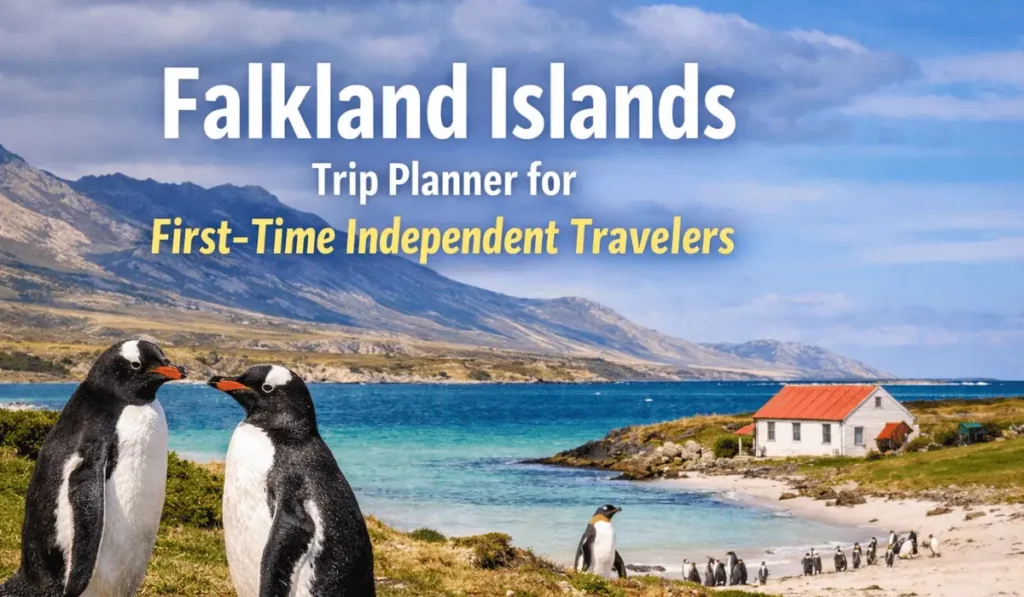
Planning the Falkland Islands on your own is possible. The official tourism site says independent travel is achievable, but it also makes clear that you need to think about flights, accommodation, and onward travel in the right order. For a first trip, the smartest plan is usually a few nights in Stanley plus one or two well-chosen outer-island or Camp stays, not an overpacked route with too many moving parts.
The big thing to understand early is that the Falklands are remote, and the trip works best when you build it around real logistics. All flights arrive at Mount Pleasant Airport on East Falkland. If you stay in Stanley first, airport bus transfers can drop you at your accommodation. If you are heading elsewhere first, your accommodation provider or tour operator usually arranges the next transfer.
Planning a first Falklands trip starts with the right trip shape
For most first-time independent travelers, the cleanest plan is one of these:
- Stanley-focused short trip for visitors with limited time
- Stanley plus one outer-island stay for a balanced first trip
- Stanley plus two carefully linked stays for travelers with more time and flexibility
That shape suits the way travel works on the islands. The tourism board highlights independent travel, island-hopping, and local accommodation advice, while official visitor information also points travelers toward Stanley’s Tourist Information Centre for maps, local guidance, and on-island support.
A first trip does not need to cover everything. The Falklands reward slower planning. The 2024 tourism report says average leisure stay reached 14.5 nights, which shows many visitors treat the destination as a longer, deeper trip. For a first independent visit, though, even a shorter plan can work well if you keep the route tight. That second point is a planning inference, but it fits the travel pattern shown in the official data.
Book your Falklands trip in this order
The order matters more here than it does in easier destinations.
| Booking step | What to decide first | Why it matters |
|---|---|---|
| 1 | Entry rules and insurance | You need valid travel documents and insurance that includes medical evacuation |
| 2 | International arrival route | Flight availability shapes the whole trip |
| 3 | First nights in Stanley or Camp | Your first base affects transfers and timing |
| 4 | Accommodation on outer islands | FIGAS bookings should follow confirmed accommodation |
| 5 | Internal flights, local drivers, tours | These depend on where you are staying and how flexible your route is |
| 6 | Cash, gear, and final buffers | Practical details matter in a remote destination |
That sequence matches official guidance. GOV.UK says passports must be valid for the duration of your stay, visitors can usually enter without a visa for up to one month, and customs rules apply. Official Falklands tourism guidance says visitors need travel insurance that includes medical evacuation, and the FIGAS page says independent travelers should confirm accommodation before booking internal flights.
Check entry rules and insurance first
Before paying deposits, confirm your passport status, entry rules, and insurance wording. GOV.UK says visitors can usually stay for one month on arrival without a visa, and your passport must be valid for the duration of your stay. The Falklands tourism site says visitors need travel insurance that includes medical evacuation by plane. FCDO advice also says insurance should match your itinerary and planned activities.
Choose your arrival route
At the moment, the public official sources point to two main arrival paths for most leisure travelers. The Falklands tourism site says LATAM is the only international airline serving the islands and lists the Mount Pleasant Airport code as MPN. It also says the Chile route operates on Saturdays. The same page notes that the midweek São Paulo service shown there has not yet been reinstated. GOV.UK also says there are weekly scheduled flights from Chile and a twice-weekly MOD-operated fare-paying service from RAF Brize Norton to Mount Pleasant.
For first-time travelers, the planning point is simple. Build your dates around the flight you can actually secure, then shape the rest of the trip around that.
Decide how much of the trip will be in Stanley
Stanley works well as a first base because it is the easiest place to settle in after arrival, sort out local details, get cash if needed, and visit the Tourist Information Centre. The centre is at the Jetty Visitor Centre on Ross Road and Philomel Street, with maps, staff support, Wi-Fi, visitor displays, and seasonal opening hours.
This matters for first-time independent travelers because Stanley is where the trip becomes easier to manage on the ground. You arrive, reset, and then move outward.
Lock in accommodation before internal flights
This is one of the most important practical points in the whole trip. The official FIGAS page says independent travelers should make sure they have accommodation confirmation before booking flights. FIGAS is not a standard scheduled airline. It works more like an air-taxi system, with daily flying based on demand, and the schedule is published the afternoon before departure.
So the order is:
- Confirm where you are staying.
- Then line up FIGAS or the next transfer.
- Keep your timing flexible.
How independent travel in the Falklands actually works
Independent travel in the Falklands is not hard in the usual sense. It is just less plug-and-play than a city break.
Mount Pleasant arrival
All flights arrive at Mount Pleasant Airport on East Falkland. Official tourism guidance says airport bus transfers are available to Stanley and can drop you directly at your accommodation. If your first stop is outside Stanley, your host or operator usually handles the onward transfer.
One practical note matters here. FCDO guidance says Mount Pleasant is a military site, and photography there requires a permit.
Stanley as your planning base
Stanley is usually the easiest first stop for an independent traveler. You can get your bearings, collect local information, visit museums or nearby wildlife spots, and use it as a base for day trips or onward travel. The Tourist Information Centre is designed as a first-stop resource for both short and longer stays.
FIGAS and outer-island travel
Outer-island travel is part of what makes the Falklands special, but it needs a different mindset. Official tourism guidance says the usual aircraft for island-hopping are Britten-Norman Islander planes, and travel around the archipelago can happen by air, land, or sea. The FIGAS visitor page says bookings should generally be made by 10 a.m. the day before, the schedule appears the afternoon before travel, and visitors should be ready to provide baggage details and body weights for planning. Visitor baggage allowance is listed as 20 kg.
That means a good first trip should leave slack in the plan. A remote island trip with no buffer is risky. A route with breathing room is far more realistic.
How many days should first-time independent travelers plan?
A short Stanley-only visit is possible, but first-time independent travelers usually get a better trip from 7 to 10 days. That gives enough time for arrival, a Stanley base, one meaningful wildlife or outer-island leg, and weather or transport flexibility. This is a planning recommendation, not an official rule, but it lines up with the destination’s remoteness, internal travel style, and the official data showing relatively long average stays.
If you only have a few days, keep the trip simple and stay mostly on East Falkland. If you have more than a week, one outer-island stay starts to make much more sense.
What to budget for before you book
Even before you price flights, think in these categories:
- international flights
- airport and local transfers
- Stanley accommodation
- outer-island accommodation
- FIGAS or private transport
- meals
- local tours or guided wildlife access
- insurance
- small cash needs
The official sources I reviewed do not publish a full standard trip budget on one page, so it is better to avoid fake certainty here. What they do show is that this is a remote destination with a long average stay and a mix of Stanley hotels, guest houses, farm stays, cottages, and lodges. The accommodation page also notes that hosts often advise visitors on wildlife conditions and best places to visit, which is especially useful for independent travelers.
Practical details first-time visitors often miss
Cash and cards
FCDO says credit and debit cards are not widely accepted outside Stanley, and there is only one ATM on the islands. It advises travelers to check card acceptance when booking and to carry cash in British pounds or US dollars. It also notes that some travelers have had trouble exchanging Falkland Islands currency in the UK.
For a first independent trip, that means you should not rely on card acceptance once you move beyond Stanley.
Health and emergency planning
The Falklands tourism site says healthcare facilities are centered on King Edward VII Memorial Hospital in Stanley and that visitors require no vaccinations. It also says non-UK residents must pay for medical services received in the islands. GOV.UK adds that medical evacuation is not covered by the UK-Falklands reciprocal healthcare agreement for UK residents and says comprehensive travel and medical insurance is needed. Emergency services can be reached on 999.
Weather and buffer time
FCDO says the weather can change rapidly and that you can experience several seasons in a single day. It also notes that poor weather can delay air travel, especially in winter. That matters for both the UK airbridge and inter-island flying.
So keep buffer time at the end of the trip if you have a critical international connection after departure.
Driving and road conditions
If you plan to self-drive, FCDO says a UK driving licence can be used in the Falklands for up to 12 months. It also warns that the Mount Pleasant to Stanley road can be hazardous in strong winds, that accidents are common, and that many roads outside Stanley are unsurfaced. Official tourism guidance adds that East and West Falkland have road networks linking key settlements, but many visitors still prefer an experienced driver-guide.
For a first trip, driver support is often the calmer option unless you are very comfortable with remote-road conditions.
A sample 7-day Falkland Islands trip plan
This is a realistic first-trip framework, not a rigid schedule.
Day 1: Arrive and stay in Stanley
Use the airport transfer, check in, rest, and get your bearings. If you arrive early enough, walk the waterfront and visit the Tourist Information Centre.
Day 2: Stanley and a nearby wildlife or history day
Keep the first full day light. Use it to settle in, sort money, and confirm any onward travel.
Day 3: Transfer to your outer-island or Camp stay
Only do this if accommodation and transport are already confirmed. FIGAS timing may not be final until the day before.
Days 4 to 5: Stay put and explore deeply
This is where independent travel pays off. One good location is often better than bouncing across too many places.
Day 6: Return toward Stanley
Do not leave the island-hop return too late if you have an international departure close behind.
Day 7: Final Stanley day or departure
Use the final day as buffer time, shopping time, or one last local visit.
The exact islands and lodges depend on your interests, budget, and season. The planning principle stays the same: keep the route clean and leave room for weather and transport realities.
Common planning mistakes to avoid
The first is trying to plan the Falklands like a normal city-hopping trip. It is not built for that.
The second is booking FIGAS before your accommodation is confirmed. The official visitor page explicitly warns against that.
The third is assuming card access will be smooth everywhere. Official advice says it will not.
The fourth is cutting the trip too fine around weather, flights, or onward connections. Official guidance on both international and local air travel makes it clear that delays can happen.
Final thoughts
A good Falkland Islands trip planner for first-time independent travelers should do one thing well: reduce friction before you book. Start with the arrival route you can actually secure, stay in Stanley first unless you have a strong reason not to, confirm accommodation before internal flights, carry the right insurance, keep some cash on hand, and leave time for the islands to run at their own pace. That approach matches the way the destination is officially set up for visitors and gives a first trip much better odds of feeling smooth, not rushed.
FAQ Section
Can you visit the Falkland Islands independently?
Yes. The official tourism site says independent travel is achievable, but travelers should pay close attention to flight options, accommodation, and internal transport planning.
Do first-time visitors need a visa for the Falkland Islands?
GOV.UK says visitors can usually enter without a visa and are granted permission to stay for one month on arrival. Travelers staying longer should check permit rules in advance.
What is the best base for a first independent trip?
Stanley is usually the easiest first base because it is where you can settle in, access visitor information, sort practical details, and connect onward.
How do you travel between islands in the Falklands?
Official tourism guidance says inter-island travel often happens on FIGAS aircraft, which work more like an air-taxi service than a fixed scheduled airline.
Do you need travel insurance for the Falkland Islands?
Yes. The tourism site says travel insurance that includes medical evacuation by plane is needed to stay in the Falklands.
Can you rely on cards outside Stanley?
Not fully. FCDO says cards are not widely accepted outside Stanley, and there is only one ATM on the islands.