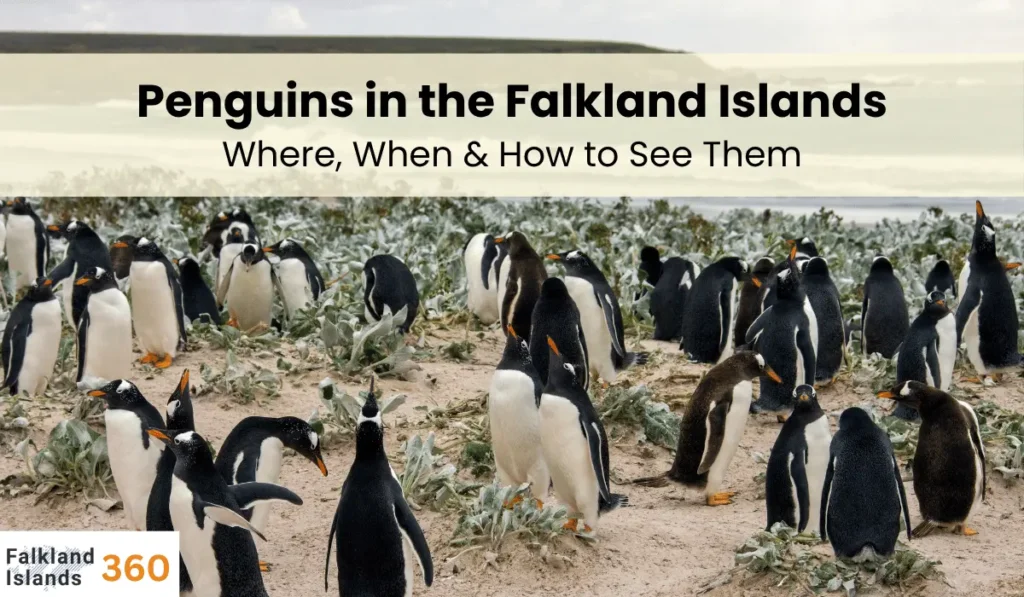


Five penguin species breed in the Falkland Islands: king, gentoo, Magellanic, southern rockhopper, and macaroni penguins. They do not all use the same habitat or appear in the same numbers, so learning the basic differences makes wildlife trips much easier to understand.
This guide focuses on identification, behavior, and habitat. If you are planning a trip and want to know where and when to see them, use our separate Falkland Islands penguin viewing guide.
The five penguin species of the Falkland Islands
- King penguin: the largest Falklands penguin, with orange-yellow markings on the head and upper chest.
- Gentoo penguin: orange-red bill, white head stripe, and a long tail that often sweeps the ground.
- Magellanic penguin: a burrow-nesting species with black-and-white facial and chest bands.
- Southern rockhopper penguin: small, energetic, and easy to recognize by yellow eyebrow crests.
- Macaroni penguin: another crested penguin, much less common in the Falklands than the other four breeding species.
King penguin
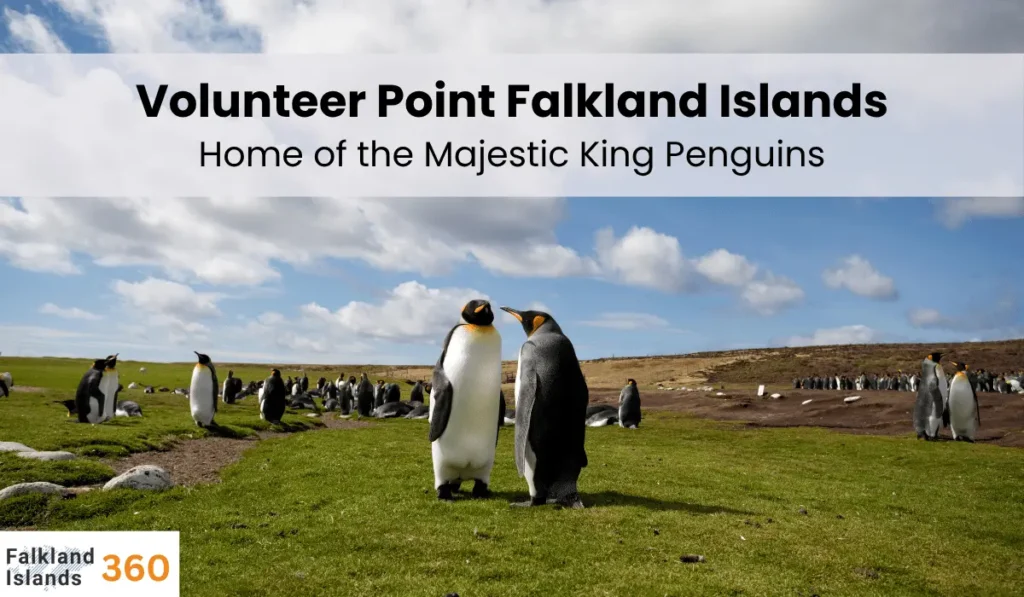
King penguins are the most visually distinctive penguins many visitors encounter. Adults are tall, upright birds with a dark head, bright orange-yellow patches near the ears and throat, and a silver-grey back.
Unlike most smaller penguins, kings have a long breeding cycle. That is why a colony can show eggs, small chicks, large brown down-covered chicks, and adults at different stages at the same time.
Volunteer Point is the best-known king penguin location in the Falklands and holds the islands’ largest breeding group.
Gentoo penguin
Gentoos are easy to identify by the broad white stripe across the top of the head, a bright orange-red bill, and orange feet. They also have a longer tail than most penguin species.
They are widespread around the Falklands and often nest in open colonies on gently sloping ground. Visitors may also see them moving in well-used paths between nesting areas and the sea.
Gentoos are among the penguins most likely to remain visible through a wider part of the year, although colony behavior changes with the season.
Magellanic penguin
Magellanic penguins are strongly associated with burrows. Rather than nesting in dense open groups, they often use burrows in soft ground, coastal slopes, or vegetation.
Adults have a black face bordered by a white band, with additional dark banding across the upper chest. At a distance, they can look less colorful than kings or crested penguins, but their burrowing behavior is a useful identification clue.
Gypsy Cove near Stanley is one of the easiest places for short-stay visitors to look for Magellanic penguins.
Southern rockhopper penguin
Southern rockhoppers are small crested penguins with yellow eyebrow feathers that extend behind the eyes. Their name comes from the way they move over steep, rocky terrain rather than waddling only across flat beaches.
They breed in noisy colonies, often on rugged coastal slopes shared with seabirds such as black-browed albatross. That combination creates some of the Falklands’ best-known cliffside wildlife scenes.
West Point and Saunders are among the better-known locations associated with rockhoppers and large seabird colonies.
Macaroni penguin
Macaroni penguins are the least common of the five breeding penguin species in the Falklands. They are crested penguins, but their orange-yellow crest is fuller and more pronounced across the forehead than a rockhopper’s thinner eyebrow-like plume.
Because they occur in much smaller numbers locally, visitors should not plan a Falklands trip around a guaranteed macaroni sighting. Think of them as a specialist target rather than a standard part of every itinerary.
How to tell rockhopper and macaroni penguins apart
Both species have yellow crests, so they are the easiest pair to confuse. Look at the shape and position of the crest. Rockhoppers have thinner yellow eyebrow feathers that project outward behind the eyes. Macaronis have a heavier orange-yellow crest that starts more prominently across the forehead.
Location and colony context also help, but appearance should come first. Do not identify a bird only because a particular species is expected at a site.
When penguin behavior changes through the year
Most penguin travel is concentrated in the southern spring and summer, when colonies are active with courtship, nesting, eggs, chicks, and fledging. The exact stage differs by species and month.
- September to November: returns, courtship, nest building, and egg laying become important.
- December to February: hatching and chick activity are major features at many colonies.
- January to March: crèches, growing chicks, and fledging become more visible.
- Winter: land-based penguin variety is lower, although king penguins remain present and some gentoo can still be seen.
Use the Falkland Islands wildlife calendar by month for the broader seasonal picture.
Penguin viewing etiquette
The Falklands can offer unusually close wildlife encounters, but visitors should not create that closeness themselves. Official guidance recommends keeping at least six metres from wildlife, staying out of an animal’s route to the sea, and following local rope lines, marked trails, or guide instructions.
If a penguin approaches while you are sitting or standing still, let it choose the distance. Do not chase it, surround it, or move closer for a photograph.
Which species should first-time visitors prioritize?
If you only have a few days, prioritize a strong location rather than trying to tick off all five species. Volunteer Point gives a classic king penguin experience, while Stanley-area sites make Magellanic viewing easier. An outer-island stay gives you a better chance to combine several species with seabirds and marine mammals.
That distinction is why this page focuses on species identification, while the where, when, and how to see penguins guide handles trip planning.
FAQs
How many penguin species breed in the Falkland Islands?
Five species breed in the Falklands: king, gentoo, Magellanic, southern rockhopper, and macaroni penguins.
Where are king penguins best known in the Falklands?
Volunteer Point is the best-known location and is described by the tourist board as having the islands’ largest breeding group of king penguins.
Are macaroni penguins common in the Falkland Islands?
No. They breed in much smaller numbers than the other four species, so a sighting should not be treated as guaranteed on a normal trip.
Can you see penguins in the Falklands in winter?
Yes, but variety is lower. King penguins remain present year-round and some gentoo also remain, while many other penguins spend more time at sea.
How close can you get to penguins?
Official visitor guidance recommends keeping at least six metres from wildlife and never blocking an animal’s route to the sea.