
The Falkland Islands have a very small population spread across a large South Atlantic archipelago. The latest full official census counted a usually resident population of 3,662 in 2021, with 2,974 usually resident in Stanley. That means roughly four in five residents live in the capital, while much of the rest of the territory remains sparsely settled.
Because population estimates can change between censuses, this page uses the latest published full-census baseline rather than presenting an unsupported 2026 headcount as an exact figure.
Falkland Islands population at a glance
- Usually resident population, 2021 census: 3,662.
- Usually resident in Stanley: 2,974.
- Usually resident in Camp: 354.
- Usually resident at Mount Pleasant Complex: 334.
- Main language: English.
- Settlement pattern: highly concentrated in Stanley, with small communities and farms across Camp and the outer islands.
The official 2021 census also recorded 3,541 people physically present on census night, but that figure includes temporary visitors. For population comparisons, the 3,662 usually resident figure is the more useful benchmark.
Where do most people live?
Stanley on East Falkland is the dominant population center. It contains the main concentration of shops, schools, healthcare, government services, accommodation, restaurants, and visitor facilities. If you are planning a first trip, that concentration is one reason Stanley works so well as the starting base.
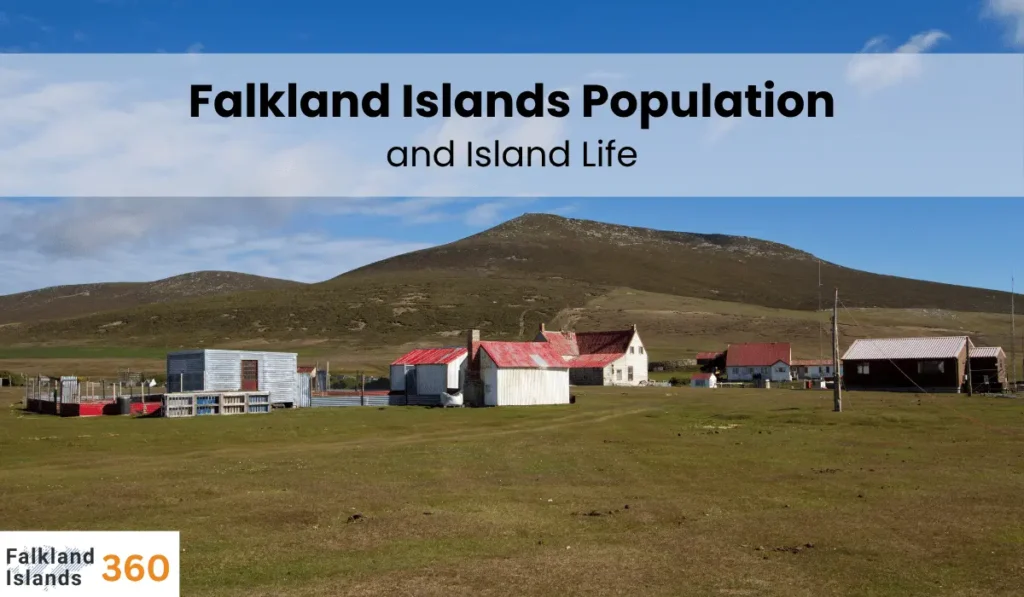
Outside Stanley, locals commonly use the word Camp for the countryside and settlements across East Falkland, West Falkland, and the smaller inhabited islands. Camp communities are much smaller, and many are tied closely to farming, tourism, conservation, transport, or other local services.
For the physical layout behind this settlement pattern, see our Falkland Islands map and geography guide.
What is daily life like in Stanley?
Stanley feels more like a small, well-serviced town than a remote outpost. Residents have access to schools, the King Edward VII Memorial Hospital, shops, pubs and cafés, sports facilities, museums, government offices, and local community organizations.
For visitors, the compact population means everyday life is visible rather than hidden behind a large tourism district. You may see school traffic, local shopping, work vehicles, cruise-day activity, and normal community life all within the same waterfront area.
What is life like in Camp?
Camp is much more dispersed. Settlements can be separated by long road distances, tracks, ferry connections, or FIGAS flights. Services are naturally thinner than in Stanley, and accommodation is often small-scale, owner-run, and closely connected to local families or farms.
That does not mean Camp travel is difficult. It means you plan differently: confirm accommodation, transport, meals, and any local guiding before arrival. Our independent Falklands trip planner explains how to sequence those bookings.
Work, economy, and community
The Falklands economy is broader than the old stereotype of sheep farming alone. Fisheries, government and public services, agriculture, tourism, construction, transport, retail, and related industries all support local employment. Sheep farming remains culturally and economically important in Camp, while Stanley supports a wider mix of jobs and services.
A small population also makes community institutions important. Sports, local events, clubs, schools, hospitality, and volunteer activity have an outsized role because the same people often meet across work, family, and social life.
Population, visitors, and Mount Pleasant
One reason Falklands population numbers can be confusing is that official datasets distinguish between people physically present, usual residents, temporary visitors, and the Mount Pleasant Complex population. The 2021 census counted 334 usual residents at Mount Pleasant Complex and separately recorded non-resident visitors.
That is why a single rounded headline such as “about 3,500 people” can be useful for casual context but should not be treated as a precise current census total.
What the small population means for travelers
- Book remote stays early: small properties have limited room inventory.
- Expect fewer services outside Stanley: plan food, cash, fuel, and transport rather than assuming city-style availability.
- Use local knowledge: hosts and guides often have the most practical current information for wildlife access and transport.
- Leave travel slack: weather and small-scale transport can affect island-hopping plans.
If your main interest is practical travel rather than demographics, start with the complete Falkland Islands travel guide and our guide to where to stay in the Falkland Islands.
Official population source
The population figures above come from the Falkland Islands 2021 Census Report. Using the official census avoids mixing temporary visitors with usual residents and gives a clear baseline for future updates.
Final takeaway
The Falkland Islands are home to only a few thousand usual residents, and most live in Stanley. That small, concentrated population shapes almost everything visitors notice: the scale of services, the strong community feel, the remoteness of Camp, and the need to plan transport and accommodation more carefully than in a larger destination.
FAQs about the Falkland Islands population
How many people live in the Falkland Islands?
The latest full official census recorded a usually resident population of 3,662 in 2021. Rounded descriptions often say about 3,500 people, but the census figure is the stronger baseline.
How many people live in Stanley?
The 2021 census recorded 2,974 usual residents in Stanley, making it by far the largest population center in the Falkland Islands.
What does Camp mean in the Falkland Islands?
Camp is the local term for the countryside and settlements outside Stanley, including communities across East Falkland, West Falkland, and smaller islands.
What language is spoken in the Falkland Islands?
English is the main language used in government, education, business, and daily life.
Does the small population affect travel?
Yes. Outside Stanley, services and accommodation are smaller and more dispersed, so travelers should arrange transport, rooms, meals, and remote-island logistics in advance.